Tape Residue and Glory: Rescuing the Pin-Ups Your Father Tacked to the Garage Wall
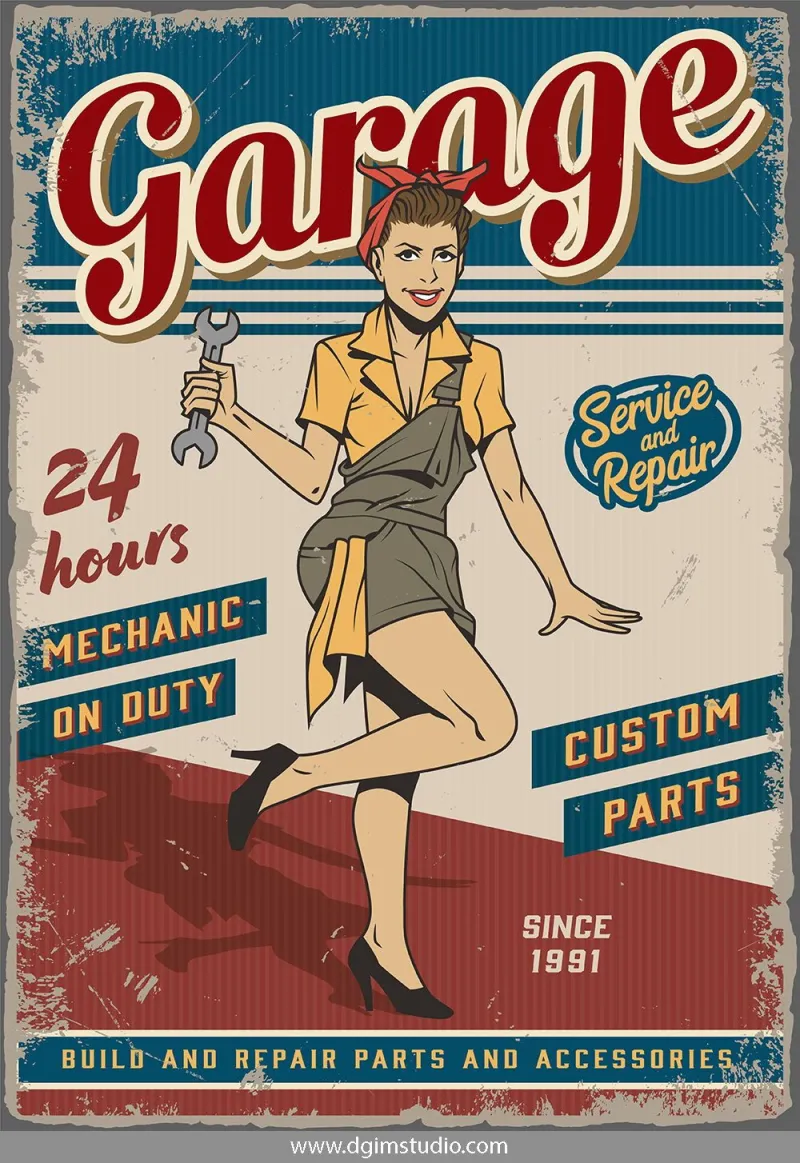
Photo: vintage pin-up poster garage workshop wall retro, via i.pinimg.com
Every kid who grew up in postwar America knew the drill. You weren't supposed to open the bottom drawer of Dad's toolbox, and you definitely weren't supposed to stare too long at the poster above the workbench. But everybody did both anyway.
Decades later, that same poster — yellowed, creased, maybe still wearing a strip of duct tape from 1974 — is sitting in a garage or basement waiting for somebody to decide its fate. Increasingly, that somebody is a grown kid with a frame shop gift card and a sudden attack of nostalgia.
Paper Icons of the Man Cave Era
Before the rec room had a flatscreen and the garage had a mini-fridge, its decoration budget went to paper. Centerfold posters, magazine cutouts, and calendar pages were the default wallpaper of American male space: one-car garages, National Guard armories, fraternity basements, the back office of the hardware store.
These weren't curated galleries. They were accumulated — a poster here, a pin-up torn from a magazine there, layered over years like sediment. A single wall could hold a 1958 calendar girl, a mid-'60s beach-blond centerfold, and a Farrah-style feathered look from the late '70s, all coexisting in cheerful anarchy.
That layering is exactly what makes them interesting now. Each tacked-up page is a timestamp of who Dad was when he put it there — young, working, dreaming.
From Embarrassment to Heirloom
For a long stretch, these posters were treated as shameful clutter. Wives wanted them down. Kids were told to avert their eyes. When a homeowner passed or downsized, boxes of them went straight to the curb.
The shift started when collectors began treating vintage men's magazines and pin-up art as legitimate pop-culture artifacts. Suddenly the same print that once hid behind the lawnmower was commanding real money at shows and online auctions. Condition, it turned out, mattered enormously — but so did story.
A pristine poster in a sleeve is nice. A poster with grease fingerprints, a pencil note in the corner ("June — don't forget!"), and a nail hole from a specific garage in Dayton, Ohio? That's provenance. Collectors and family members alike have learned to love the scars, because the scars prove the thing was lived with, not just owned.
The Restoration Boom
Walk into any vintage paper fair from Pasadena to Pittsburgh and you'll find a new breed of enthusiast: the family restorer. These are folks who rescued a roll of posters from an attic or an estate sale and want to do right by them.
The basics of the craft have spread fast:
- Dry it out gently. Decades of garage humidity warp paper. Flatten slowly under weight with absorbent blotters — never with a hot iron.
- Kill the acidity. Archival folders and acid-free backing boards are cheap and stop the slow browning that eats vintage pulp paper.
- Skip the amateur tape. Pressure-sensitive tape from the hardware store is the enemy. Conservators can remove old tape; fresh tape just adds a new problem.
- Frame with UV glass. Garage posters have already survived enough light. Keep the sun off them now.
Some purists go further, paying professionals to deacidify and mend tears with Japanese tissue. Others take a simpler route: high-resolution scanning, careful digital cleanup, and a museum-quality reprint that hangs in the den while the fragile original sleeps in an archival box. Both approaches honor the thing. Nobody's judging.
What Makes One Poster Worth More Than Another
Condition and provenance now drive the market, but a few other factors matter:
The subject. Classic Vargas-style illustration and the iconic photographic covers of the golden age carry the strongest demand. Obscure one-off posters from regional printers can be sleeper hits precisely because so few survived.
The printing. Original lithographs have a richness that later offset reprints can't match. Under a loupe, collectors look for the tell-tale dot patterns that date a piece.
The wall it came from. A poster documented as coming from a specific barracks, shop, or family garage — with photos or letters to back it up — trades at a premium. Collectors aren't just buying paper. They're buying the American room it lived in.
More Than a Pretty Face on the Wall
There's a temptation to treat all of this as pure nostalgia, but the garage pin-up did real cultural work. It was one of the few pieces of art ordinary working men owned and chose themselves. It said something about aspiration, humor, and taste at a time when taste was something you weren't supposed to have if you owned a socket set.
That's why the restoration movement feels less like collecting and more like rescue. Every flattened and framed poster is a small argument that the everyday American interior — the garage, the barracks, the shop — deserves its place in the story too.
So before the next garage cleanout, take a second look at what's taped above the bench. If you're lucky, you'll find a curling sheet of 1962 with a blonde grinning through the grease smoke. Flatten it. Sleeve it. Hang it somewhere with better light.
Dad would understand. He always said it was for the articles.